
info@sadnica.ba+387 66 763 696


Select your language
Select your language
 0
0Select your language
Devil Gala
Italy
MM106
Late August to early September
Gala Devil (or Devil Gala) is a clone of the Gala apple with specific traits that distinguish it from other Gala varieties. It is a spontaneous mutant of Royal Gala, discovered in Italy. The discovery is attributed to the Italian nursery Vivai F.lli Zanzi (Ferrara, Italy), which first registered and propagated this clone due to its exceptionally dark color and uniform fruits. Gala Devil is primarily known for its visual and organoleptic qualities, making it ideal for fresh consumption and markets that value attractive apples. It is suitable for supermarkets, fruit shops, and premium fruit packages. To a lesser extent, it can be used for processing – e.g., juices and salads – although its high sugar content and juiciness make fresh consumption the primary use. Market advantage for growers includes early ripening and visual appeal, allowing fruits to sell at higher prices.
Sweet, juicy, and very appealing to most consumers, which explains its popularity in the fresh fruit market.
The fruit is medium to large, typically 65–80 mm in diameter, but can be larger under optimal conditions. Shape is slightly conical to round, typical for Gala varieties. Fruits are uniform, which is advantageous for commercial sales. The skin is deep dark red, almost purplish. The background color is yellow-orange, creating a visually striking contrast. The flesh is crisp, firm yet juicy, and highly flavorful. Fruits ripen earlier than classic Gala varieties, allowing early market entry.
-
You can purchase seedlings of Apple Gala Devil at our garden center in the nursery located at Gornjem Crnjelovu, Glavna 65a.
Upon collection of the goods (seedlings), the Agromedžik nursery no longer has the possibility of supervision or care, and therefore cannot provide any further guarantee. Since seedlings are living beings, it is not possible to give a guarantee even a day after they leave the nursery. We cannot influence their maintenance and care, and consequently their further growth and development.
Our plants regularly undergo phytosanitary and vegetative inspections, therefore we do not have diseased or infected plants.
Planting is done from late October to mid-April, avoiding periods of frost and drought.
Trim the roots, then the branches into 3 to 4 rings. At the beginning of March, cut the seedlings to a height of 80 - 120 cm.
Before planting, soak the plant in water for at least 2 - 3 hours.
Dig a hole, in the previously prepared soil, measuring 60 x 60 x 50 cm for the soil (40 x 40 x 40 cm) so that the roots and part of the stem are well placed, taking care that the grafting point is outside the soil.
Place the plant in the hole and cover it with dry soil, gently press it down so that it gets well between the roots.
Fertilizer and seedling roots must not be in direct contact.
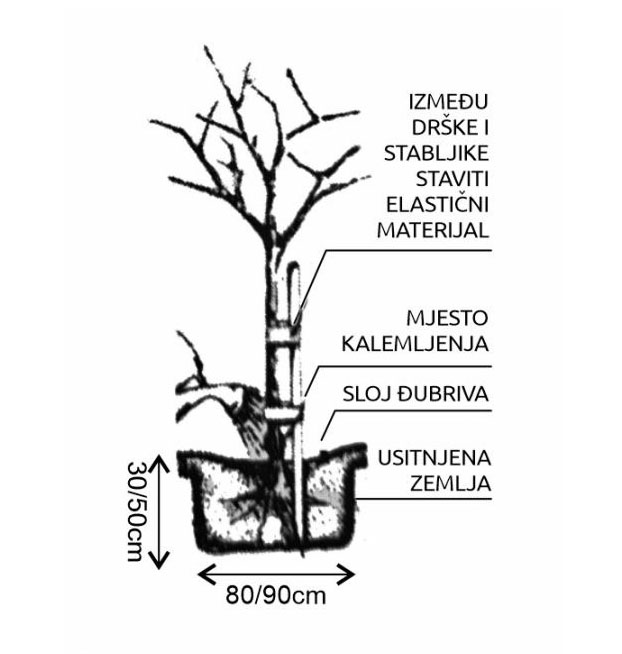
Pour with 20-30 liters of water. During periods of drought in the first year of planting, it is necessary to water young seedlings more often.
Containerized seedlings can be planted throughout the year.
*Applies to bare root seedlings.


