
info@sadnica.ba+387 66 763 696


Select your language
Select your language
 0
0Select your language
Traminac, Aromatic Traminac, Red Traminac, Savagnin Rose, Gewürztraminer, Traminer, Savagnin Blanc, White Traminac
Italy
Cober 5 bb
-
Traminac is a grape variety cultivated worldwide. It is believed to originate from northern Italy in the Tyrolean Alps, near the village of Tramin in Alto Adige, where the first varietal of this grape thrived. There are three variations based on skin color: red, white, and pink or yellow. This single variety has mutated over time into several color forms, confirmed by recent genetic studies. The variety is renowned globally and highly prized. Wines produced from Traminac are very distinctive, highly aromatic, and often low in acidity. Careful attention to harvest timing is essential, as late harvesting can result in wines that are overly alcoholic, unbalanced, and yellowish in color.
The pulp is juicy, sweet, and aromatic. In poor years, sugar content reaches 18–20%, and often exceeds 20%. When overripe, acidity drops significantly. Wines from these varieties always differ. Red Traminac produces strong, full-bodied wines with a subtle aroma. Aromatic Traminac has a noble fragrance with hints of exotic fruit. It often exhibits elegant rose tones and, after several years of aging, can achieve outstanding quality.
Clusters are small and compact. Berries are small, round, lighter or darker red, with abundant bloom, thick skins, juicy, sweet, and aromatic. Within the Traminac group, several variations exist, the most known being red, white, and aromatic. Red Traminac berries are red-purple, while aromatic ones are pink with yellowish-brown hues. Aromatic Traminac tends to shrivel slightly, whereas Red Traminac does not.
Self-pollinating.
It has good resistance to low temperatures. Budbreak occurs moderately late, protecting it from spring frosts.
You can purchase seedlings of Traminac grape at our garden center in the nursery located at Gornjem Crnjelovu, Glavna 65a.
Upon collection of the goods (seedlings), the Agromedžik nursery no longer has the possibility of supervision or care, and therefore cannot provide any further guarantee. Since seedlings are living beings, it is not possible to give a guarantee even a day after they leave the nursery. We cannot influence their maintenance and care, and consequently their further growth and development.
Our plants regularly undergo phytosanitary and vegetative inspections, therefore we do not have diseased or infected plants.
The depth of the pit is 40-50 cm, and the width is 30-40 cm.
First, a 5-6 cm layer of loose, fertile soil is placed at the bottom of the pit.
Cut the root of the vine seedling to 10 to 12 cm from the main stem (substrate).
Insert the vine seedling into the hole at an angle of 45°. The connection point of the coil should be 2-3 cm above the ground surface.
Once the seedling is placed in the hole, a layer of crumbly, fertile, and moderately moist soil is spread over the roots. The applied soil layer is then firmly pressed down.
The graft is supported by hand below the grafting point so that it does not move during pressing and compacting.
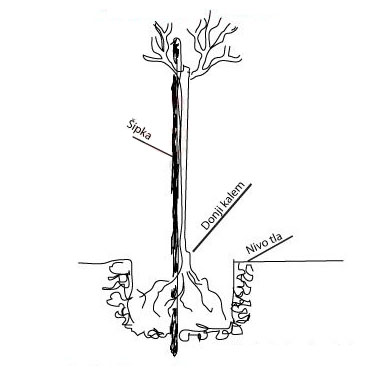
After the pressing and compacting of the soil is completed, the seedling is watered with 5 liters of water.
Then the remaining upper part of the hole is filled with a mixture of soil and organic fertilizer. The soil is first mixed with well-rotted manure, and then this mixture is poured into the hole and firmly compacted by pressing.
In autumn planting, apply finely crumbled soil over the planted seedling and form a mound so that only 1–2 cm of the branches remain exposed. The mound protects the seedling from freezing during the winter.
In spring planting, it is not necessary to form a mound.


