
info@sadnica.ba+387 66 763 696


Select your language
Select your language
 0
0Select your language
Merlo, Merlot, Merlau, Plant Medoc
France
Cober 5 bb
Late September
Merlot began being used as a quality wine grape variety in 1784. Its wider cultivation spread across Europe and other continents by the late 18th century. Studies indicate that it originated from a spontaneous cross between Cabernet Franc (father) and Magdeleine Noire, varieties from the Charente region. It closely resembles the Carménère variety, which is evidenced by millions of liters of wine produced in Chile being labeled as Merlot on the global market. Merlot is one of the most reliable wine grape varieties for cultivation, ripening two weeks earlier than Cabernet Sauvignon. Its wines are well-colored, harmonious, refreshing, with flavors of berries such as cherries and plums, alongside distinctive varietal aromas. Merlot ranks among the most important red varieties for producing premium red wines and has significant commercial value, requiring propagation solely from clonal material.
Merlot is known for its smooth, velvety texture and rich fruit flavors, including blackberries, plums, and cherries. It can also exhibit secondary notes of chocolate, coffee, and tobacco, as well as tertiary flavors of leather and earthy tones as it ages. The flavor profile varies depending on region, climate, and winemaking techniques.
The grape cluster is medium-sized, cylindrical, and loose, with one or two wings (shoulders), weighing 140–180 grams. The berries are lighter blue than Cabernet, with higher sugar and lower tannins, large and often unevenly ripened. Each berry has thin skin and is sensitive to external conditions; size varies depending on the Merlot clone. Berries are medium-sized, round, blue, and have a strong bloom. Sugar content ranges from 18 to 22%, with acidity between 6 and 8‰.
Self-pollinating.
Highly frost-resistant. Medium resistance to downy and powdery mildew, and good resistance to Botrytis. Very resilient to low winter temperatures.
You can purchase seedlings of Merlot grape at our garden center in the nursery located at Gornjem Crnjelovu, Glavna 65a.
Upon collection of the goods (seedlings), the Agromedžik nursery no longer has the possibility of supervision or care, and therefore cannot provide any further guarantee. Since seedlings are living beings, it is not possible to give a guarantee even a day after they leave the nursery. We cannot influence their maintenance and care, and consequently their further growth and development.
Our plants regularly undergo phytosanitary and vegetative inspections, therefore we do not have diseased or infected plants.
The depth of the pit is 40-50 cm, and the width is 30-40 cm.
First, a 5-6 cm layer of loose, fertile soil is placed at the bottom of the pit.
Cut the root of the vine seedling to 10 to 12 cm from the main stem (substrate).
Insert the vine seedling into the hole at an angle of 45°. The connection point of the coil should be 2-3 cm above the ground surface.
Once the seedling is placed in the hole, a layer of crumbly, fertile, and moderately moist soil is spread over the roots. The applied soil layer is then firmly pressed down.
The graft is supported by hand below the grafting point so that it does not move during pressing and compacting.
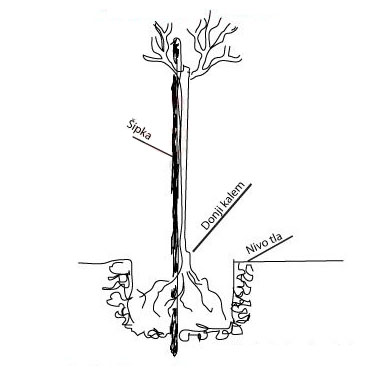
After the pressing and compacting of the soil is completed, the seedling is watered with 5 liters of water.
Then the remaining upper part of the hole is filled with a mixture of soil and organic fertilizer. The soil is first mixed with well-rotted manure, and then this mixture is poured into the hole and firmly compacted by pressing.
In autumn planting, apply finely crumbled soil over the planted seedling and form a mound so that only 1–2 cm of the branches remain exposed. The mound protects the seedling from freezing during the winter.
In spring planting, it is not necessary to form a mound.


