
info@sadnica.ba+387 66 763 696


Select your language
Select your language
 0
0Select your language
Citrus limon
China, India, Pakistan
-
May to September
The lemon is a tree of the Citrus genus, and its fruit. Lemon is a beautiful and highly decorative evergreen plant. Like all other citrus trees, lemons are sensitive to low temperatures, so it is easiest to grow them in large pots so they can be brought indoors during winter. Lemons thrive in full sunlight, so if you want them to bloom indoors, place them near a window. Commercially, lemons are divided into yellow and green varieties, although they grow on the same tree. Lemon is one of the most beneficial foods on the planet. It protects against a wide range of illnesses and is rightly considered a superfood. Regular consumption can prevent conditions such as laryngitis, bronchitis, flu, colds, arthritis, high blood pressure, bacterial infections, kidney and gallstones, and according to recent studies, even certain cancers. A glass of lemon water first thing in the morning has a surprisingly positive effect on health.
The fruit has a juicy and sour taste.
The fruit is yellow, with a colorless interior, oval to almost round in shape, usually slightly indented at the stem and pointed at the opposite end. The peel can be slightly rough or smooth, and the inner side is lined with a white spongy layer called albedo, which is not edible. Lemons contain 40–50% juice. The juice is yellow to pale green and sour in taste. It contains up to 8% citric acid, smaller amounts of other organic acids, around 3% sugar, and is rich in vitamins, especially vitamin C.
-
Lemon is one of the most sensitive citrus species to winter cold. It does not tolerate low temperatures well. Temperatures of -5 °C can cause significant damage or even kill the entire plant.
You can purchase seedlings of Lemon Tree at our garden center in the nursery located at Gornjem Crnjelovu, Glavna 65a.
Upon collection of the goods (seedlings), the Agromedžik nursery no longer has the possibility of supervision or care, and therefore cannot provide any further guarantee. Since seedlings are living beings, it is not possible to give a guarantee even a day after they leave the nursery. We cannot influence their maintenance and care, and consequently their further growth and development.
Our plants regularly undergo phytosanitary and vegetative inspections, therefore we do not have diseased or infected plants.
Planting is done from late October to mid-April, avoiding periods of frost and drought.
Trim the roots, then the branches into 3 to 4 rings. At the beginning of March, cut the seedlings to a height of 80 - 120 cm.
Before planting, soak the plant in water for at least 2 - 3 hours.
Dig a hole, in the previously prepared soil, measuring 60 x 60 x 50 cm for the soil (40 x 40 x 40 cm) so that the roots and part of the stem are well placed, taking care that the grafting point is outside the soil.
Place the plant in the hole and cover it with dry soil, gently press it down so that it gets well between the roots.
Fertilizer and seedling roots must not be in direct contact.
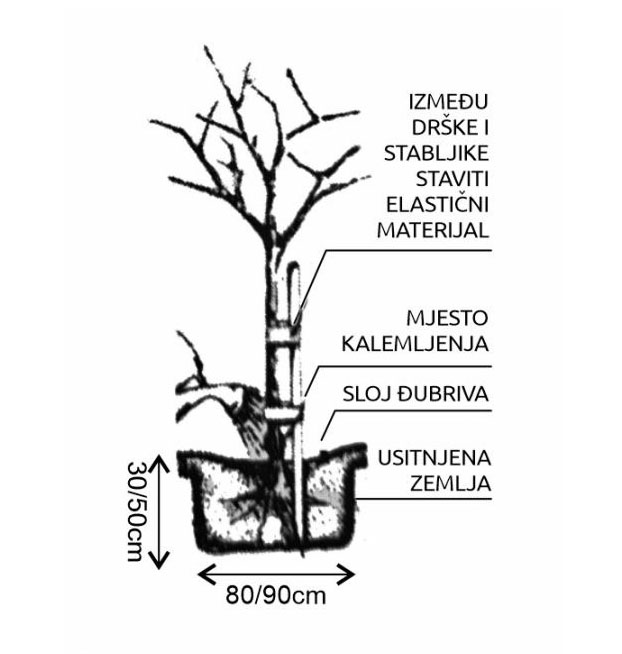
Pour with 20-30 liters of water. During periods of drought in the first year of planting, it is necessary to water young seedlings more often.
Containerized seedlings can be planted throughout the year.
*Applies to bare root seedlings.


