
info@sadnica.ba+387 66 763 696


Select your language
Select your language
 0
0Select your language
Ribes rubrum, Red Currant, Bearberry
Europe
-
July, August
Red currant (Ribes rubrum) is a member of the Ribes genus within the gooseberry family, originating from Europe. Highly valued as a berry fruit, it is rich in proteins, malic, citric, tartaric acids, and gamma-linolenic acid. It contains calcium and phosphorus, and is abundant in B vitamins (B1, B2, B3, B6), as well as vitamins C, A, and K. Red currants are an excellent source of antioxidants and minerals that improve skin and hair quality, aid in body detoxification, and boost immunity. They contain vitamin C and iron, which helps prevent anemia, and support blood vessels and bone health. Acting as a diuretic and digestive tonic, red currants are beneficial whether eaten fresh or processed into juice or jelly, providing mild laxative effects.
The berries are juicy with a pleasantly tart flavor.
The fruit is a red, round berry measuring 8–10 mm, juicy yet tart, containing multiple small seeds. It consists of about 84% water, 5% invert sugar, over 3% organic acids (mainly citric acid), 1.5% pectin, and approximately 40 mg of vitamin C and 35 mg of calcium. A notable advantage of red currants is that once ripened, the berries can remain on the branches for 4 to 6 weeks without losing quality.
Self-pollinating.
Not sensitive to low temperatures. Flowers can withstand temperatures down to -5 °C.
You can purchase seedlings of Red Currant at our garden center in the nursery located at Gornjem Crnjelovu, Glavna 65a.
Upon collection of the goods (seedlings), the Agromedžik nursery no longer has the possibility of supervision or care, and therefore cannot provide any further guarantee. Since seedlings are living beings, it is not possible to give a guarantee even a day after they leave the nursery. We cannot influence their maintenance and care, and consequently their further growth and development.
Our plants regularly undergo phytosanitary and vegetative inspections, therefore we do not have diseased or infected plants.
Planting is done from late October to mid-April, avoiding periods of frost and drought.
Trim the roots, then the branches into 3 to 4 rings. At the beginning of March, cut the seedlings to a height of 80 - 120 cm.
Before planting, soak the plant in water for at least 2 - 3 hours.
Dig a hole, in the previously prepared soil, measuring 60 x 60 x 50 cm for the soil (40 x 40 x 40 cm) so that the roots and part of the stem are well placed, taking care that the grafting point is outside the soil.
Place the plant in the hole and cover it with dry soil, gently press it down so that it gets well between the roots.
Fertilizer and seedling roots must not be in direct contact.
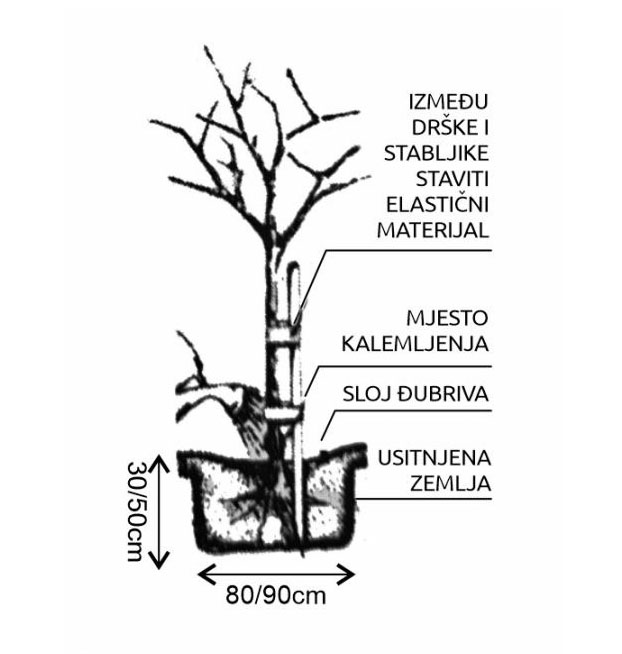
Pour with 20-30 liters of water. During periods of drought in the first year of planting, it is necessary to water young seedlings more often.
Containerized seedlings can be planted throughout the year.
*Applies to bare root seedlings.


