
info@sadnica.ba+387 66 763 696


Select your language
Select your language
 0
0Select your language
Ribes nigrum
USA
-
July, August
Black currant (Ribes nigrum) is a type of berry belonging to the genus Ribes. Studies have shown that it can inhibit the growth of cancer cells. The raw fruit is especially rich in vitamin C and polyphenols. Black currants can be eaten fresh, but are usually cooked in sweet or savory dishes. They are used for making jams, jellies, and syrups, and are commercially grown for the juice market. The fruit is also used for alcoholic beverages and natural colorings. Black currants contain proteins, malic, citric, tartaric acids, and gamma-linolenic acid. They are rich in calcium and phosphorus, and abundant in B vitamins (B1, B2, B3, and B6), as well as vitamins C, A, and K. Black currants are an excellent source of antioxidants and minerals that improve skin and hair quality. They aid in body detoxification, boosting immunity, and support blood vessels and bone health.
The berries have a tart flavor.
The fruits are edible berries, very dark purple, almost black, with glossy skin and persistent calyx at the top, each containing many seeds. A single bush can produce about 4.5 kilograms of fruit annually.
Self-pollinating.
Winter-hardy, although frost during flowering in spring can reduce crop size.
You can purchase seedlings of Black Currant at our garden center in the nursery located at Gornjem Crnjelovu, Glavna 65a.
Upon collection of the goods (seedlings), the Agromedžik nursery no longer has the possibility of supervision or care, and therefore cannot provide any further guarantee. Since seedlings are living beings, it is not possible to give a guarantee even a day after they leave the nursery. We cannot influence their maintenance and care, and consequently their further growth and development.
Our plants regularly undergo phytosanitary and vegetative inspections, therefore we do not have diseased or infected plants.
Planting is done from late October to mid-April, avoiding periods of frost and drought.
Trim the roots, then the branches into 3 to 4 rings. At the beginning of March, cut the seedlings to a height of 80 - 120 cm.
Before planting, soak the plant in water for at least 2 - 3 hours.
Dig a hole, in the previously prepared soil, measuring 60 x 60 x 50 cm for the soil (40 x 40 x 40 cm) so that the roots and part of the stem are well placed, taking care that the grafting point is outside the soil.
Place the plant in the hole and cover it with dry soil, gently press it down so that it gets well between the roots.
Fertilizer and seedling roots must not be in direct contact.
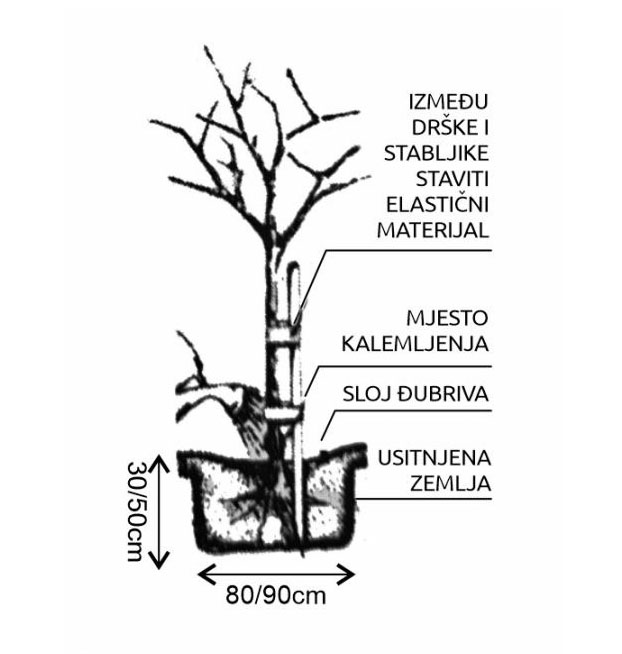
Pour with 20-30 liters of water. During periods of drought in the first year of planting, it is necessary to water young seedlings more often.
Containerized seedlings can be planted throughout the year.
*Applies to bare root seedlings.


