
info@sadnica.ba+387 66 763 696


Select your language
Select your language
 0
0Select your language
Tilia
Europe, Western Asia
-
Late summer, early autumn
The linden (Tilia) is a very well-known and widespread tree in Europe and in our region, considered one of the most significant traditional and cultural trees. It is a large, long-lived, and decorative deciduous tree from the genus Tilia. The linden originates from Europe and Western Asia but is now widespread throughout the temperate climate zone. It is planted in parks, avenues, courtyards, and around homes. For centuries, the linden has been associated with human life—because of its appearance, shade, and medicinal properties, it was often used as the central tree of a village or churchyard and is considered part of cultural tradition. The linden has a wide and traditional use: it is best known for its medicinal flowers, which are harvested and used for teas, syrups, and other herbal preparations because they have calming effects and help with colds, coughs, insomnia, and stress. This tree is highly valuable for beekeeping, producing aromatic and medicinal linden honey. Due to its large, symmetrical crown and dense shade, it is often planted in parks, avenues, and courtyards as an ornamental and protective tree. Linden wood is soft and easy to work with, making it suitable for carving, icon painting, sculpture, and musical instruments. The linden also has cultural and symbolic significance—it has long been considered a tree of home, peace, and community, and in many regions, communities would gather under it.
The fruit is not edible.
The fruit is a small, hard nut, usually grouped in clusters attached to a characteristic long, leathery bract (wing). The fruits are lightweight and easily carried by the wind, which helps with the natural spreading and regeneration of the species.
-
Linden is extremely frost-resistant and tolerant of urban conditions, handles drought well, rarely gets diseases, and is generally not very sensitive to pests.
You can purchase seedlings of Linden tree 2 years old at our garden center in the nursery located at Gornjem Crnjelovu, Glavna 65a.
Upon collection of the goods (seedlings), the Agromedžik nursery no longer has the possibility of supervision or care, and therefore cannot provide any further guarantee. Since seedlings are living beings, it is not possible to give a guarantee even a day after they leave the nursery. We cannot influence their maintenance and care, and consequently their further growth and development.
Our plants regularly undergo phytosanitary and vegetative inspections, therefore we do not have diseased or infected plants.
Planting is done from late October to mid-April, avoiding periods of frost and drought.
Trim the roots, then the branches into 3 to 4 rings. At the beginning of March, cut the seedlings to a height of 80 - 120 cm.
Before planting, soak the plant in water for at least 2 - 3 hours.
Dig a hole, in the previously prepared soil, measuring 60 x 60 x 50 cm for the soil (40 x 40 x 40 cm) so that the roots and part of the stem are well placed, taking care that the grafting point is outside the soil.
Place the plant in the hole and cover it with dry soil, gently press it down so that it gets well between the roots.
Fertilizer and seedling roots must not be in direct contact.
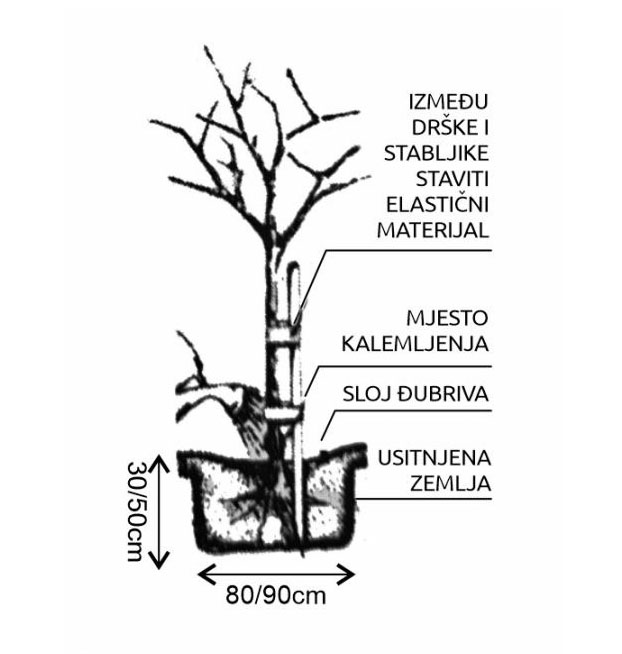
Pour with 20-30 liters of water. During periods of drought in the first year of planting, it is necessary to water young seedlings more often.
Containerized seedlings can be planted throughout the year.
*Applies to bare root seedlings.


