
info@sadnica.ba+387 66 763 696


Select your language
Select your language
 0
0Select your language
Mardžarka, Hungarian Plum, Bistrica, Hauszwetsche (German), Quetsche (French/German), Blue Plum, Prune Plum.
Asia
-
Late August to early September
The Požegača Plum is an old European plum variety of unknown precise origin, but it has long been widespread throughout the Balkans, Hungary, Austria, and Germany. It is believed to have developed naturally through the selection of wild plums and centuries of traditional cultivation, becoming one of the most iconic traditional Prunus domestica varieties. The Požegača Plum holds great cultural and economic significance in Europe, historically serving as the primary variety for producing dried prunes and premium slivovitz (plum brandy). It is also used for making jams, compotes, and preserves, as well as for fresh consumption. However, it is not suitable for long storage due to its thin skin and juicy flesh.
Interesting fact: The Požegača Plum was once the most widespread plum variety in Central and Eastern Europe, though its cultivation area has decreased due to its susceptibility to plum pox virus. Despite this, it remains a symbol of traditional plum growing and processing across the Balkans.
Sweet and aromatic flavor with a perfect balance of sugars and acids.
The fruit is small to medium-sized, typically weighing 15–25 g. It has an oval to elongated shape, sometimes slightly asymmetrical. The skin is thin, smooth, dark blue to purple, with a noticeable waxy coating. The flesh is yellow to greenish-yellow, firm yet juicy, highly aromatic, and easily separates from the stone. The pit is small, oval, and free. The juice is sweet, rich in natural sugars, and delicately balanced with mild acidity – ideal for drying and brandy production.
-
You can purchase seedlings of Plum Požegača - Madžarka at our garden center in the nursery located at Gornjem Crnjelovu, Glavna 65a.
Upon collection of the goods (seedlings), the Agromedžik nursery no longer has the possibility of supervision or care, and therefore cannot provide any further guarantee. Since seedlings are living beings, it is not possible to give a guarantee even a day after they leave the nursery. We cannot influence their maintenance and care, and consequently their further growth and development.
Our plants regularly undergo phytosanitary and vegetative inspections, therefore we do not have diseased or infected plants.
Planting is done from late October to mid-April, avoiding periods of frost and drought.
Trim the roots, then the branches into 3 to 4 rings. At the beginning of March, cut the seedlings to a height of 80 - 120 cm.
Before planting, soak the plant in water for at least 2 - 3 hours.
Dig a hole, in the previously prepared soil, measuring 60 x 60 x 50 cm for the soil (40 x 40 x 40 cm) so that the roots and part of the stem are well placed, taking care that the grafting point is outside the soil.
Place the plant in the hole and cover it with dry soil, gently press it down so that it gets well between the roots.
Fertilizer and seedling roots must not be in direct contact.
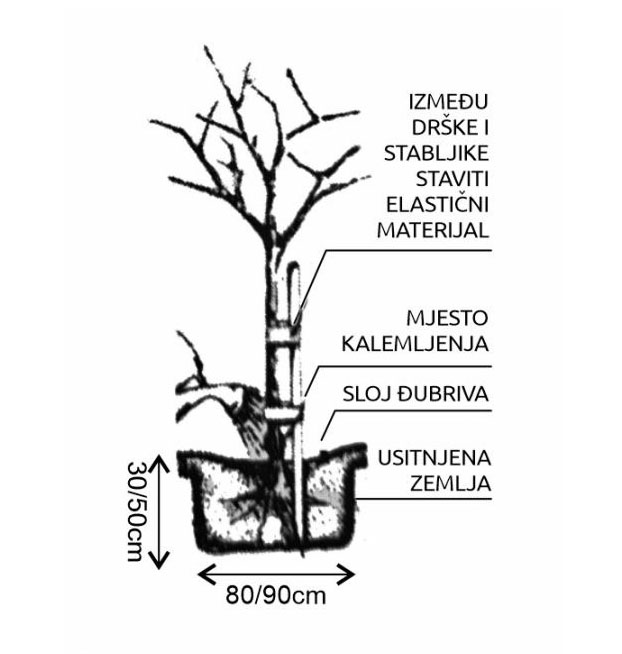
Pour with 20-30 liters of water. During periods of drought in the first year of planting, it is necessary to water young seedlings more often.
Containerized seedlings can be planted throughout the year.
*Applies to bare root seedlings.


