
info@sadnica.ba+387 66 763 696


Select your language
Select your language
 0
0Select your language
Godži, Lycium chinese, or Lycium barbarum
China
-
August, September
Goji berries are the fruit of the woody Goji plant, which belongs to the Solanaceae family, including tomatoes, potatoes, and eggplants. Goji is primarily cultivated for consumption, but it can also be grown as an ornamental plant. Although native to the Himalayas and China, it has adapted well to other regions and can be easily cultivated locally. Goji is mainly grown for its medicinal fruits, which are highly energetic and rank among the top foods worldwide for antioxidant content that helps slow aging. The berries have a low glycemic index, aiding in weight management without stimulating overeating. They can be eaten fresh without preparation, or dried and added to porridge or baked goods.
Fresh berries have a sweet flavor reminiscent of cherries and cranberries.
The fruit is a reddish, oval berry up to 2 cm long, containing 20 to 40 tiny brown seeds.
-
Young plants are initially very sensitive and of varying growth, so they are often cultivated in greenhouses during the first year before being planted in open fields. Planting is generally recommended in spring after the risk of frost has passed. Since Goji is not native to local areas, there are no significant diseases or pests that directly threaten the plant.
You can purchase seedlings of Goji Tree at our garden center in the nursery located at Gornjem Crnjelovu, Glavna 65a.
Upon collection of the goods (seedlings), the Agromedžik nursery no longer has the possibility of supervision or care, and therefore cannot provide any further guarantee. Since seedlings are living beings, it is not possible to give a guarantee even a day after they leave the nursery. We cannot influence their maintenance and care, and consequently their further growth and development.
Our plants regularly undergo phytosanitary and vegetative inspections, therefore we do not have diseased or infected plants.
Planting is done from late October to mid-April, avoiding periods of frost and drought.
Trim the roots, then the branches into 3 to 4 rings. At the beginning of March, cut the seedlings to a height of 80 - 120 cm.
Before planting, soak the plant in water for at least 2 - 3 hours.
Dig a hole, in the previously prepared soil, measuring 60 x 60 x 50 cm for the soil (40 x 40 x 40 cm) so that the roots and part of the stem are well placed, taking care that the grafting point is outside the soil.
Place the plant in the hole and cover it with dry soil, gently press it down so that it gets well between the roots.
Fertilizer and seedling roots must not be in direct contact.
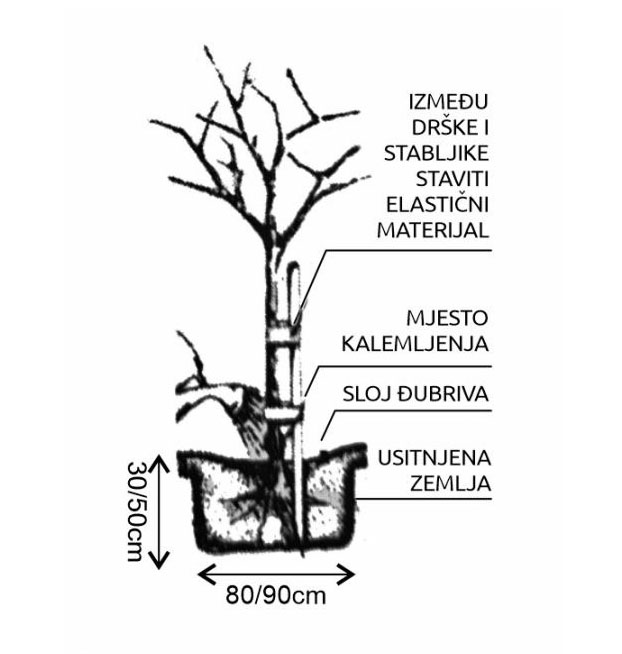
Pour with 20-30 liters of water. During periods of drought in the first year of planting, it is necessary to water young seedlings more often.
Containerized seedlings can be planted throughout the year.
*Applies to bare root seedlings.


