
info@sadnica.ba+387 66 763 696


Select your language
Select your language
 0
0Select your language
-
Southwest Asia and the Eastern Mediterranean
-
-
The fig is a deciduous shrub or small tree widely cultivated for its edible fruit. Fossil evidence suggests that figs were grown long before wheat and barley, making them one of the earliest examples of organized agricultural production. Figs can be eaten fresh, preserved, or dried.
The fruit’s flesh is naturally sweet.
The fig fruit is fleshy, sweet, and pear-shaped. Based on color, figs can be classified into three main types: green-yellow, purple, and dark purple-black fruits.
-
Figs are a thermophilic (heat-loving) fruit species. Cold tolerance largely depends on the maturity of the tree. During dormancy, fig trees can withstand temperatures down to -15 °C, although they do not tolerate prolonged periods below -10 °C. Thanks to their well-developed root system, figs are relatively drought-tolerant and can grow on uncultivated terrain.
You can purchase seedlings of Fig at our garden center in the nursery located at Gornjem Crnjelovu, Glavna 65a.
Upon collection of the goods (seedlings), the Agromedžik nursery no longer has the possibility of supervision or care, and therefore cannot provide any further guarantee. Since seedlings are living beings, it is not possible to give a guarantee even a day after they leave the nursery. We cannot influence their maintenance and care, and consequently their further growth and development.
Our plants regularly undergo phytosanitary and vegetative inspections, therefore we do not have diseased or infected plants.
Planting is done from late October to mid-April, avoiding periods of frost and drought.
Trim the roots, then the branches into 3 to 4 rings. At the beginning of March, cut the seedlings to a height of 80 - 120 cm.
Before planting, soak the plant in water for at least 2 - 3 hours.
Dig a hole, in the previously prepared soil, measuring 60 x 60 x 50 cm for the soil (40 x 40 x 40 cm) so that the roots and part of the stem are well placed, taking care that the grafting point is outside the soil.
Place the plant in the hole and cover it with dry soil, gently press it down so that it gets well between the roots.
Fertilizer and seedling roots must not be in direct contact.
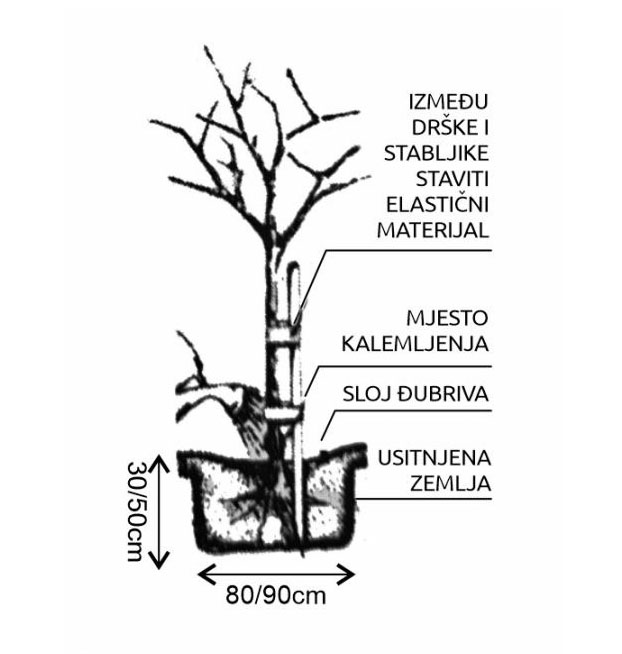
Pour with 20-30 liters of water. During periods of drought in the first year of planting, it is necessary to water young seedlings more often.
Containerized seedlings can be planted throughout the year.
*Applies to bare root seedlings.


