
info@sadnica.ba+387 66 763 696


Select your language
Select your language
 0
0Select your language
Roxana apricot, Roxana Kecskei rózsa
Afghanistan
Džanarika, Interstock
Late July – Early August
Roxana is the most sought-after apricot variety after Hungarian Best. Originating from Afghanistan, it was named Roxana in Bulgaria after introduction and trials. It was brought to Yugoslavia after World War II from Bulgaria. The variety is attractive for the market, tolerates transport well, and is primarily used for fresh consumption, though it can also be processed.
The flesh is moderately juicy, sweet-tart, with a moderately pronounced aroma.
The fruits are very large (60–70 grams, with some exceeding 100 grams), round-oval in shape, slightly flattened on the sides. A moderately pronounced groove divides the fruit into symmetrical halves. The base skin color is orange, with intense red overtones, mostly evenly distributed, covering a large portion of the surface. The flesh is orange, firm, moderately juicy, and of high quality, with a sweet kernel.
Self-pollinating.
Relatively resistant to diseases and low temperatures. Partially resistant to the sharka virus.
You can purchase seedlings of Apricot Roxana at our garden center in the nursery located at Gornjem Crnjelovu, Glavna 65a.
Upon collection of the goods (seedlings), the Agromedžik nursery no longer has the possibility of supervision or care, and therefore cannot provide any further guarantee. Since seedlings are living beings, it is not possible to give a guarantee even a day after they leave the nursery. We cannot influence their maintenance and care, and consequently their further growth and development.
Our plants regularly undergo phytosanitary and vegetative inspections, therefore we do not have diseased or infected plants.
Planting is done from late October to mid-April, avoiding periods of frost and drought.
Trim the roots, then the branches into 3 to 4 rings. At the beginning of March, cut the seedlings to a height of 80 - 120 cm.
Before planting, soak the plant in water for at least 2 - 3 hours.
Dig a hole, in the previously prepared soil, measuring 60 x 60 x 50 cm for the soil (40 x 40 x 40 cm) so that the roots and part of the stem are well placed, taking care that the grafting point is outside the soil.
Place the plant in the hole and cover it with dry soil, gently press it down so that it gets well between the roots.
Fertilizer and seedling roots must not be in direct contact.
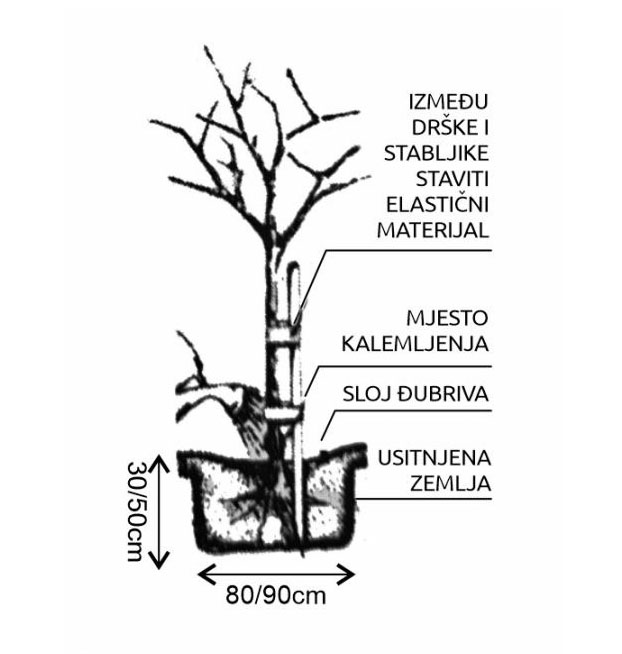
Pour with 20-30 liters of water. During periods of drought in the first year of planting, it is necessary to water young seedlings more often.
Containerized seedlings can be planted throughout the year.
*Applies to bare root seedlings.


